All Services
Our Services

TV Walls & Niches

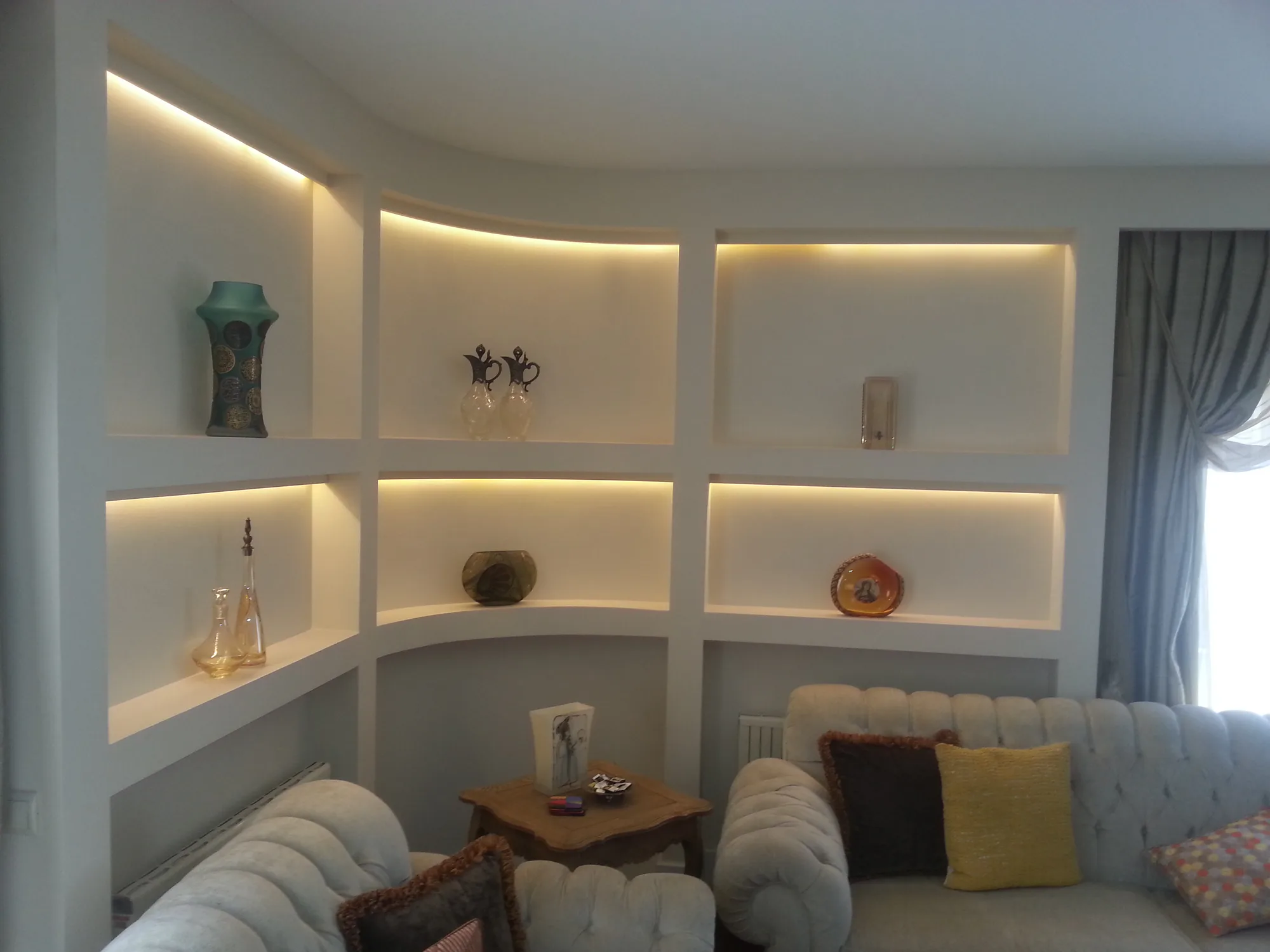
TV recesses, shelving and concealed lighting details. Cable routes and socket positions are solved before the boards close up.

Reply within one business day · Free survey · Written scope and quote

Updated:
TV Walls & Niches
2007
established

What is a plasterboard TV wall?

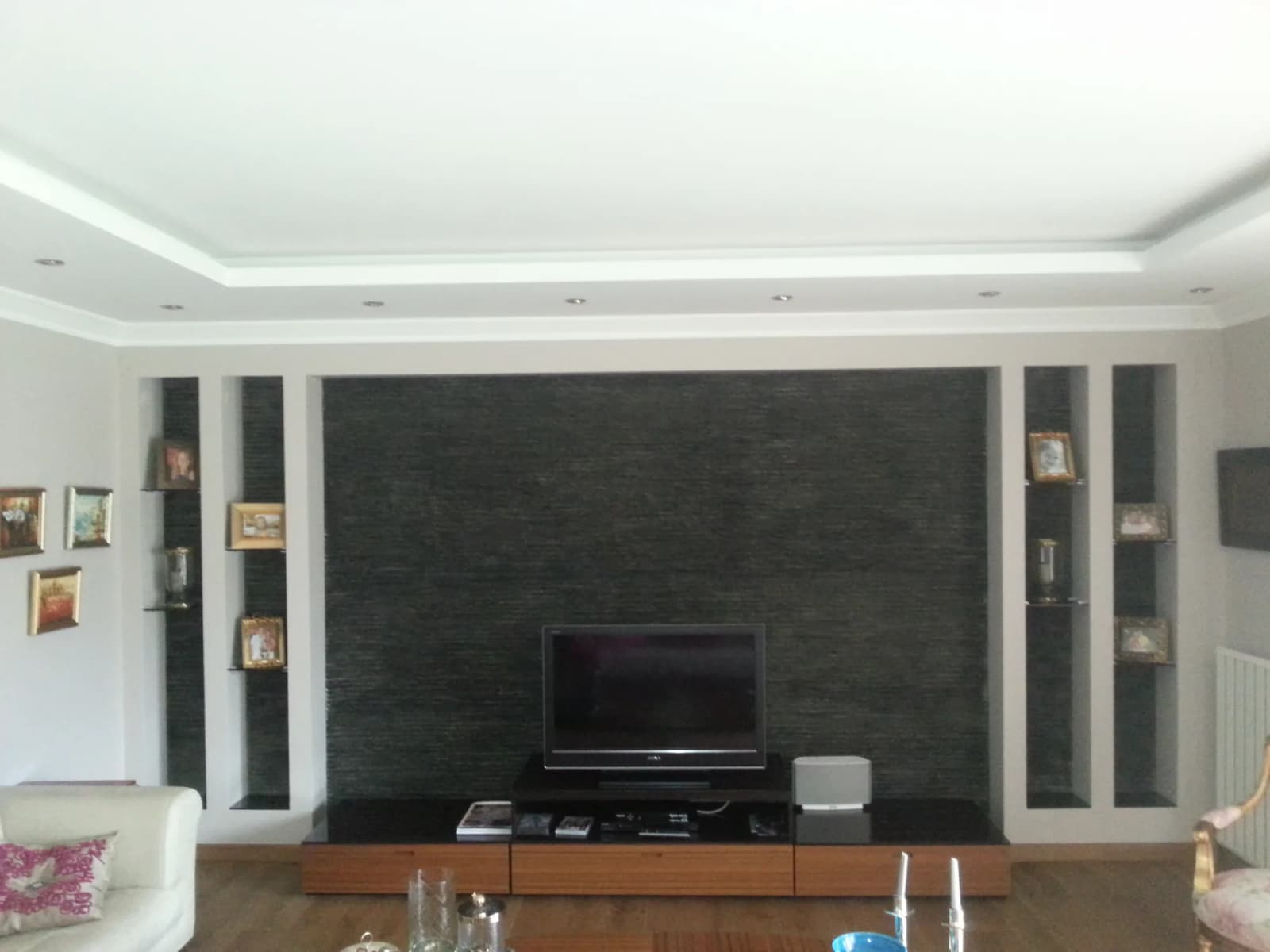
A drywall TV unit is a recessed TV area and niche system built into a living-room or bedroom wall with plasterboard. It is designed to the wall's size and use, with shelves, niches, concealed cabling and hidden LED details.

What We Offer

Modern TV unit

Minimal, functional layouts.

Wall niches

Recesses for decorative objects.

LED lighting

Concealed LED strips around the niche.

Full-wall treatment

An integrated unit running the length of the wall.

Who is it for?

TV Walls & Niches is suitable for homes, villas, offices and commercial spaces.

What affects price?

Area, selected brand/model, detail level, lighting and site conditions.

What is included?

Measurement, scope, material brand/model, workmanship and delivery terms are stated in writing.

Application process

Consultation, free survey, written quote, scheduled work and clean handover.

How We Work

At Ekin Dekorasyon ve Yapı Sistemleri the survey, the written scope and the clean handover work the same way on every project.

  • Designed to the wall's size and use
  • Dimensioned to your room
  • Concealed LED lighting
  • Cables run inside the wall
  • One-year workmanship warranty

Our Process

1

Preliminary assessment and survey

We first assess the job remotely and take measurements on site once the scope is clear.

2

Design & quote

We propose a solution that fits your needs and a detailed price quote.

3

Materials & preparation

Materials are sourced and the installation plan is prepared.

4

Planned installation

We carry out the work to plan, carefully and cleanly.

5

Handover

The work is completed and handed over within the scope and terms set in the written quote and contract.

FAQ

Frequently Asked Questions About TV Walls & Niches

We have compiled the topics our clients are most curious about

How long does it take?

The duration depends on the size and details of the unit: a standard unit usually takes 3–5 days, LED and custom-detailed designs 5–7 days. The exact duration is stated in the written quote.

Will my TV be securely mounted?

Yes. Reinforcement goes in at TV height before the wall is closed; its type is chosen according to the screen's weight and the bracket.

Can a fireplace be added?

Yes, an electric fireplace can be built in.

Can you add shelving?

Open shelves and niches are built in drywall; sections with doors are planned per project.

Will it still work if I change my TV later?

Yes. Cable conduits and modular compartments mean the TV and other electronics can be swapped later.

How heavy a TV can a drywall unit carry?

With reinforcement, the limit is the bracket rather than the wall. For scale: a 55-inch set runs about 15–20 kg, a 65-inch around 25 kg, a 75-inch 35–45 kg. Those loads are never carried by cavity anchors. While the frame is open we build a steel or timber noggin at the mounting position and the bracket screws straight into it, so the load reaches the structure rather than the board. For an articulating arm we widen the reinforcement, because the leverage multiplies the moment several times over.

How is the niche sized?

Not from the screen size but from the set's actual outer dimensions — the width of a 65-inch TV with its bezel varies by manufacturer. We leave 8–10 cm each side and 5–10 cm above: enough to get a hand in, and enough for ventilation. Depth is TV thickness plus bracket thickness; with a fixed flat mount a typical niche is 12–15 cm deep. A niche built with no allowance becomes unusable the moment the TV is replaced.

How do the cables run inside the wall?

We never bury cable directly in the wall — we install conduit and run the cable through it. The reason is simple: cable standards change. If today's HDMI run becomes something else, conduit lets the new cable be pulled without opening the wall, and we leave a draw string in place for exactly that. Power and signal go in separate conduits; a mains cable sharing a conduit can put interference into both picture and sound.

Is bias lighting behind the TV worth doing?

Not essential, but noticeably easier on the eyes. Looking at a bright screen in a dark room is tiring because of the contrast gap; soft light thrown onto the wall from behind the set closes that gap. We fit the LED strip to the rear edge of the screen, 3–5 cm off the wall. Neutral white around 6500 K keeps colour judgement honest; warm white gives a more settled living-room feel. Keeping the strip and its driver reachable for service matters.

Will the niche still fit if I change the TV later?

It will if we plan for it. Rather than sizing the niche exactly to today's set, we size it to take the next size up — a niche planned for 65 inches usually accepts 75. The VESA hole pattern is common enough that the bracket suits most brands. What really decides it is conduit and reinforcement: with both in place a new TV goes up in a couple of hours; without them, the wall has to be opened.

Can you carry out the work while I am abroad?

Yes. We agree the scope in writing before starting, send dated progress photographs at each stage, and can hold a video call on site whenever you want to see something specific. Keys are handed over against a written record, and the flat is cleaned and photographed again at handover.

How is the scope agreed and what does the written quote contain?

After the survey you receive a written scope listing the rooms and areas covered, the system chosen for each, the brand and product of the boards, profiles and insulation, the surface finish level, and the number of working days. Anything not on that list is not in the price, which is what stops the mid-project additions that make contractor quotes unreliable. Nothing is charged beyond the written scope without your approval.

How long before the property is usable or ready to let?

Ceilings and partitions leave the space usable as soon as the crew finishes. Painting needs longer: the film cures over roughly a week, and the smell in a ventilated flat clears within two to three days. If a flat is being prepared for tenants, plan on a few extra days after handover for airing and cleaning rather than scheduling a viewing for the day of completion.

How can I pay, and do you offer instalments?

You can pay by credit card through the QNB LinkPOS secure payment infrastructure. Instalments are available on QNB, Enpara and HSBC Advantage credit cards; credit cards from other banks can be used for a single payment. Payments are processed through 3D Secure. Cash and bank transfer are also possible.
Our Projects

TV Walls & Niches completed work

Get a Quote for Your Project

Send us the location and scope of the job, with photos if you have them; we reply within one business day.

We also take on this work as part of a complete renovation: Renovation and Interior Refurbishment

Call NowWhatsApp